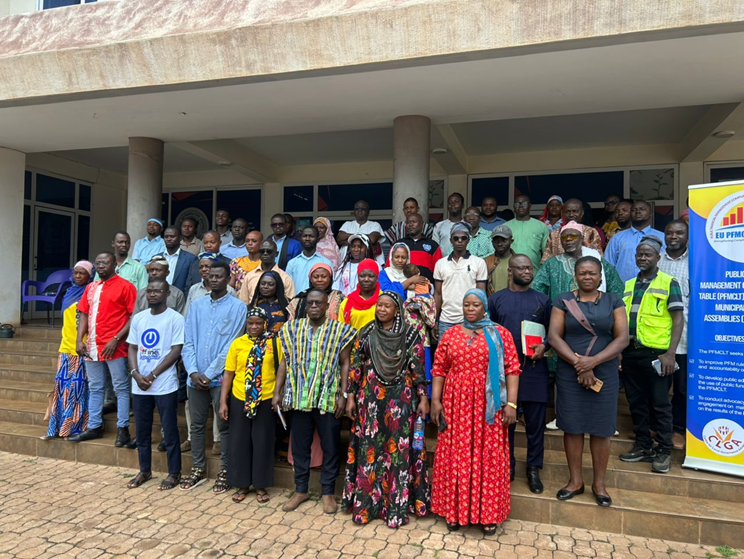
As part of deliberate efforts to deepen citizen engagement, promote transparency, and strengthen accountability in local governance, the Public Financial Management Compliance League Table (PFMCLT) Project, implemented by the Centre for Local Governance Advocacy (CLGA), successfully organised four zonal town hall meetings across Ghana’s Southern, Eastern, Middle, and Northern zones.
The zonal town hall meetings served as critical platforms for disseminating and unpacking the findings of the PFMCLT assessment at the sub-national level. They brought together a broad and diverse range of stakeholders, including ordinary citizens, traditional authorities, civil society organisations, local government officials, assembly members, and the media. This inclusive approach ensured that discussions around public financial management were grounded not only in technical evidence but also in lived community experiences.
Through these interactive regional engagements, participants gained first-hand insight into the performance of Metropolitan, Municipal and District Assemblies (MMDAs) under the PFMCLT framework. The sessions created space for open dialogue on compliance gaps, service delivery challenges, and opportunities for reform, while enabling citizens and stakeholders to reflect collectively on practical actions required to strengthen financial management and accountability at the district level.
Beyond the zonal town hall meetings, the project expanded its outreach through innovative, community-based sensitisation activities, including engagements in churches and mosques, implemented at no additional cost to the project. By leveraging trusted faith-based and community structures, CLGA ensured that PFMCLT findings reached wider and often underrepresented audiences, thereby reinforcing inclusivity, grassroots participation, and civic awareness within Ghana’s accountability and transparency agenda.
In total, the town hall engagements reached over 400 participants nationwide, effectively transforming each zone into a hub for dialogue on fiscal responsibility, transparency, and good governance. Citizens were equipped with knowledge and practical tools to better understand public financial management processes and to hold duty bearers accountable, while feedback gathered during the sessions is expected to inform future advocacy, policy dialogue, and reform efforts aimed at improving MMDA compliance.
The meetings were graced by the presence of distinguished personalities, including a Metropolitan Coordinating Director who formally welcomed participants, and the Presiding Member of the Sagnerigu Municipal Assembly, who also serves as the Dean of Presiding Members. Their participation, alongside Executive Directors of civil society organisations, Assembly Members, and media representatives, underscored a shared national commitment to transparent, accountable, and effective public financial management.
By creating safe and inclusive spaces for dialogue, learning, and citizen engagement, the zonal town hall meetings not only amplified public awareness of the PFMCLT but also strengthened citizen ownership of the accountability process. The initiative represents a significant step towards ensuring that Ghana’s local governance system remains open, responsive, and firmly anchored in the principles of transparency, fiscal discipline, and participatory governance.
The zonal town hall meetings served as critical platforms for disseminating and unpacking the findings of the PFMCLT assessment at the sub-national level. They brought together a broad and diverse range of stakeholders, including ordinary citizens, traditional authorities, civil society organisations, local government officials, assembly members, and the media. This inclusive approach ensured that discussions around public financial management were grounded not only in technical evidence but also in lived community experiences.
Through these interactive regional engagements, participants gained first-hand insight into the performance of Metropolitan, Municipal and District Assemblies (MMDAs) under the PFMCLT framework. The sessions created space for open dialogue on compliance gaps, service delivery challenges, and opportunities for reform, while enabling citizens and stakeholders to reflect collectively on practical actions required to strengthen financial management and accountability at the district level.
Beyond the zonal town hall meetings, the project expanded its outreach through innovative, community-based sensitisation activities, including engagements in churches and mosques, implemented at no additional cost to the project. By leveraging trusted faith-based and community structures, CLGA ensured that PFMCLT findings reached wider and often underrepresented audiences, thereby reinforcing inclusivity, grassroots participation, and civic awareness within Ghana’s accountability and transparency agenda.
In total, the town hall engagements reached over 400 participants nationwide, effectively transforming each zone into a hub for dialogue on fiscal responsibility, transparency, and good governance. Citizens were equipped with knowledge and practical tools to better understand public financial management processes and to hold duty bearers accountable, while feedback gathered during the sessions is expected to inform future advocacy, policy dialogue, and reform efforts aimed at improving MMDA compliance.
The meetings were graced by the presence of distinguished personalities, including a Metropolitan Coordinating Director who formally welcomed participants, and the Presiding Member of the Sagnerigu Municipal Assembly, who also serves as the Dean of Presiding Members. Their participation, alongside Executive Directors of civil society organisations, Assembly Members, and media representatives, underscored a shared national commitment to transparent, accountable, and effective public financial management.
By creating safe and inclusive spaces for dialogue, learning, and citizen engagement, the zonal town hall meetings not only amplified public awareness of the PFMCLT but also strengthened citizen ownership of the accountability process. The initiative represents a significant step towards ensuring that Ghana’s local governance system remains open, responsive, and firmly anchored in the principles of transparency, fiscal discipline, and participatory governance.
